Two people hold a bow between them, pulling against each other. The arrow points directly at one person's heart. Both lean backward, resisting gravity, trusting the other not to let go.
What keeps them in balance is neither the bow nor the arrow. It is the relationship between them.
Marina Abramović and Ulay's Rest Energy was one of the works we explored during The Transformative Power of Design, a two-day workshop I co-facilitated with Cemil Cihan Özalevli at Istanbul Modern.
The performance became a powerful metaphor for a question we kept returning to: How do we design with powerful technologies without losing sight of the relationships, responsibilities, and people affected by them?
Artificial intelligence now sits at the heart of design. It is becoming almost impossible to think about the future of any profession without understanding what AI can do and experiencing it firsthand.
Like the bow in Rest Energy, AI is a powerful instrument. It can amplify our abilities, but it can also amplify harm. We spend a great deal of time discussing what this technology makes possible, and far less time discussing what it takes to maintain balance as its power grows.
And whether we see ourselves as holding the bow or facing the arrow often depends on where we stand.
For an architect, AI might look like a competitor capable of taking over parts of their work. For the investor commissioning the same project, it might represent a faster, more affordable way to get things done. The technology hasn't changed. Our position in relation to it has.
In Power and Progress, Daron Acemoglu and Simon Johnson remind us that this tension is not new. During the Industrial Revolution, technological advances did not automatically translate into shared prosperity. Who controlled the technology, how it was deployed, and whose interests it served determined how its benefits were distributed.
Technology creates possibilities. Human choices determine who benefits from them.
We often describe design as problem-solving. But much of our effort begins only after a problem has emerged. With AI's extraordinary ability to process information, recognize patterns, and expand what individuals and teams can accomplish, we have an opportunity to move from solving problems to anticipating and preventing them.
That shift also demands a different understanding of good design. It is no longer enough to ask whether something works, how efficiently it performs, or how much value it creates. We also need to ask what kind of relationships it produces, what unintended consequences it might have, and whether the value it creates is shared.
Throughout the two days, we explored these questions together.
Participants first experienced the hands-on learning activities we developed for students using Twin AI & Coding Kits. Rather than simply talking about curiosity, experimentation, and collaboration, we invited everyone to experience how these qualities emerge through making, testing, questioning, and learning together.
From there, we explored a broader design challenge: Can we create systems that give back as much as they take? Systems that strengthen human capabilities rather than gradually diminish them?
We brought the questions. The answers emerged through our conversations, different perspectives, and the willingness to challenge familiar assumptions.
I keep coming back to Rest Energy. In the performance, neither person can maintain the balance alone. Each person's safety depends on the other's awareness, judgment, and responsibility.
Perhaps that is also the challenge of designing with AI. The question is not simply how much more powerful our tools can become, but whether we can develop the collective awareness and responsibility to use that power well.
Thank you to Istanbul Modern for creating the space for this exploration, to Cemil Cihan Özalevli for the collaboration, and to every participant for bringing curiosity, openness, and the courage to question what design can and should do.
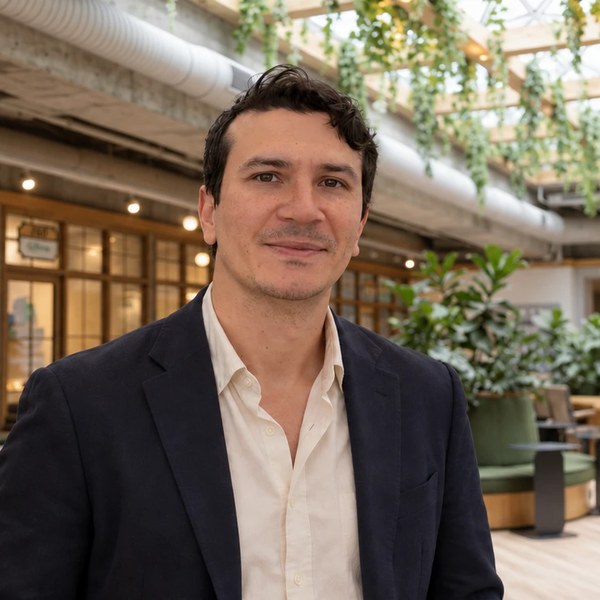
Ali Muhsin Harmancı
Entrepreneur, product / design leader and education innovator. About